Checklist · Support at Home
Support at Home Care Plan checklist and template.
Use this template to set out a Support at Home Care Plan, and the checklist to test one before it is approved. A plan passes when it has everything it should include, was prepared the right way, and works: personal to the client, current, true to their assessments, clear about risks, offered to them and used by the workers who deliver their care. Most plans that fail don't miss a section. They fill every section with words that could describe anyone.
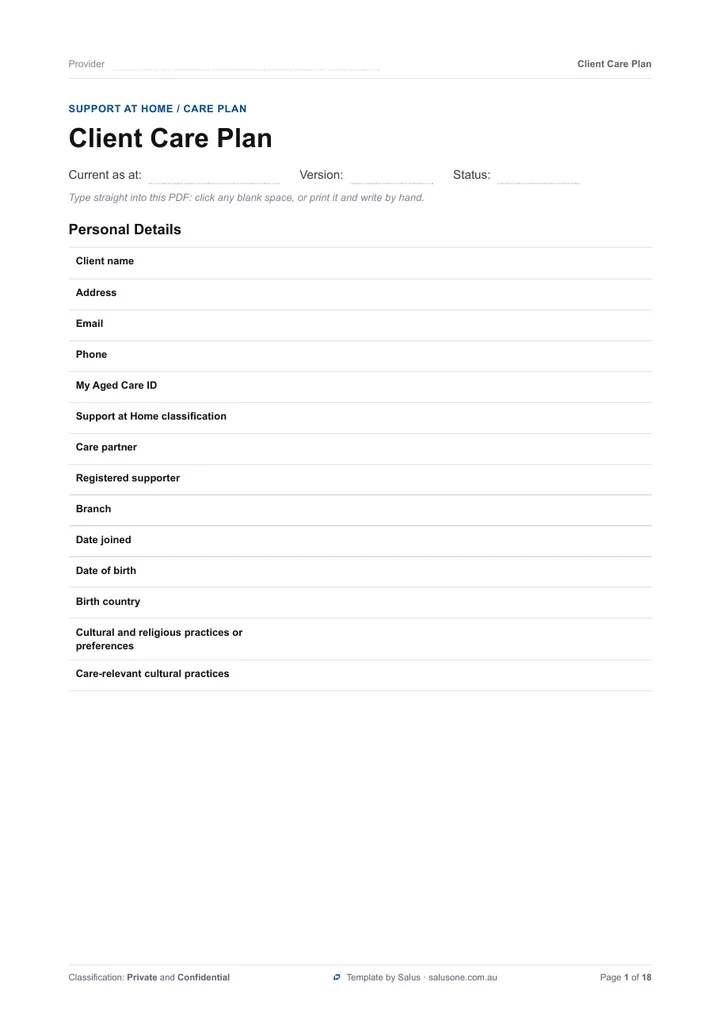
Free templatesSupport at Home Care Plan template and checklistTwo fillable PDFs: the plan, and the checklist to test it before it is approved. No sign-up.
Key points
A Care Plan should include the client's goals, strategies to reach them, their preferences, the services they have agreed to (who, when and how often), any assistive technology or home modifications with their costs, dates to review the plan and the service agreement, strategies to identify and manage risks, and notes on culturally safe, trauma-aware and healing-informed delivery.
It is prepared with the client, or their carer or registered supporter, in line with their Notice of Decision and support plan, before or on the day care starts, in language the client understands, with an individualised budget alongside.
The strengthened Quality Standards add the test of whether it works: individualised, current, true to assessments, clear about risks and how workers help manage them, offered to the client and used by workers.
The client gets a copy when it is complete, whenever it changes and whenever they ask.
Where this comes from: the Department's Support at Home guidance and the strengthened Aged Care Quality Standards, linked at the end. For the full picture of how Care Plans fit into care management, see our guide to Support at Home Care Plans.
The template
Client Care Plan
11 sections, set out like the plans Salus prepares
- Personal Details
- About the Client
- Care Plan Service Summary
- Allied Health Referral Recommendations
- Clinical Risk and Vulnerability Profile Snapshot
- Social Needs
- Health & Medical Needs
- Physical Needs
- Psychological Needs
- Complex & Vulnerability Needs
- Review and Consent
The checklist
Before approval
29 checks, before approval and at every review
- Personal Details and Communications4
- About the Client2
- Services3
- Each domain7
- How it was prepared7
- Whether it works3
- Review and Consent3
The template.
This structure covers everything a Care Plan should include, plus the details that make a plan usable. Adapt the headings to your own format.
Support at Home
Client Care Plan
Personal Details
Who the client is and how to reach them and the people they want involved
About the Client
What matters to them, their strengths and routines, how they like to be supported and what they want to keep doing, in their words
Care Plan Service Summary
The agreed services and any approved assistive technology or home modifications, matching the service agreement and the individualised budget
Allied Health Referral Recommendations
Referrals to consider and why, for your clinicians and the client to decide
Clinical Risk and Vulnerability Profile Snapshot
The rating in each domain from the client's assessment, and the highest of them as the overall rating
Social Needs
The client's social circumstances, supports and environment that affect their wellbeing, independence and ability to take part in their community
Health & Medical Needs
Health conditions, medicines and clinical factors that need monitoring, treatment or coordinated care
Physical Needs
Mobility, personal care and daily living: what the client does for themselves and where they need support
Psychological Needs
Mood, cognition, sleep, stress and anything else that affects the client's emotional wellbeing
Complex & Vulnerability Needs
Needs that cut across domains or put the client at greater risk, such as living alone, carer strain, or complex medicines
Review and Consent
When the plan is reviewed, what brings the review forward, who has a copy, and the client's consent and acknowledgement
The checklist.
Run through it before a plan is approved, and again at each review.
Personal Details and Communications
0 of 4 ticked
About the Client
0 of 2 ticked
Services
0 of 3 ticked
Each domain
0 of 7 ticked
How it was prepared
0 of 7 ticked
Whether it works
0 of 3 ticked
Review and Consent
0 of 3 ticked
Five ways plans fail, and the fix for each.
| What reviewers find | Why it matters | The fix |
|---|---|---|
| Goals copied from the last client | The plan stops being about this person | Write goals in the client's own words, during the conversation |
| “As required” instead of what is required | A new worker can't act on it | Say what, when and how, in one line each |
| Statements with no date | No one can tell what is current | Date anything that came from a record, and note where it came from |
| Services that drift from the agreement or budget | The plan, the agreement and the budget disagree | Check all three together whenever one changes |
| Risks named without instructions | A risk on paper isn't a risk managed | Add what the worker does about each risk |
Using the checklist across a team.
A checklist is most useful when it is used the same way by everyone. Three habits help:
Peer review a few plans each month, with a care partner checking a colleague's plan against the checklist.
Track which checks fail most often. If “services match the budget” keeps failing, the fix is a process, not a reminder.
Use the same checklist for new plans and reviews, so a plan that passed a year ago is tested again on the same terms.
Our guide to when to review a Support at Home Care Plan covers what brings a review forward and how to run one.
Where Salus fits.
Salus prepares
Salus prepares a draft Care Plan in your format from a client's records, marks each part with the record it came from, and lists what is missing or conflicting, which covers many of the “whether it works” checks before your care partner starts.
Your team decides
Your care partner talks with the client, makes the changes and approves the plan. Salus doesn't decide services or classifications. Draft Ready means ready for your team's review, never approved.
Questions.
The client's goals, strategies to reach them, their preferences, the agreed services with who, when and how often, any assistive technology or home modifications with their costs, dates to review the plan and the service agreement, strategies to identify and manage risks, and notes on culturally safe, trauma-aware and healing-informed delivery.
Ask Salus
There is a list of what a Care Plan should include, not a mandatory template. The structure above covers the list.
Ask Salus
At least once every 12 months, and sooner when the client asks or their needs, services, risks or supports change.
Ask Salus
That is up to your organisation. A peer review by another care partner, using the same checklist each time, keeps plans consistent across a team.
Ask Salus
Sources.
Every fact in this checklist comes from these official sources. The web pages were opened and read on 2 November 2026; chapters 7 and 8 of the program manual were read in full on 3 November 2026.
- Care plans for Support at Home participants
Department of Health, Disability and Ageing
- Last updated
- 31 October 2025
- Used for
- What a Care Plan should include; preparing it with the client in line with the Notice of Decision and support plan; the budget alongside; copies; the 12-month review
- Outcome 3.1: Assessment and planning
Aged Care Quality and Safety Commission
- Last updated
- 16 October 2025
- Used for
- The "whether it works" tests: individualised, current, true to assessments, risks and how workers help, offered to the client, used by workers
- Aged Care Rules 2025
Federal Register of Legislation
- Last updated
- Compilation No. 12, 1 October 2026
- Used for
- The same plan requirements as law
- Support at Home program manual, version 4.4
Department of Health, Disability and Ageing
- Last updated
- September 2026
- Used for
- Chapters 7 and 8 read in full on 3 November 2026: what a care plan should include, decision-making and communication preferences, copies, reviews
General information for providers, not legal or clinical advice. Check the official sources for your own circumstances.

See Salus in action.
See a draft Care Plan checked against this list, with our team.