Guide · Support at Home
Support at Home Care Plans: from assessment to a plan that stays current.
A Support at Home Care Plan sets out a client's needs, goals and preferences, and the approved services that will meet them. A care partner prepares it with the client before or on the day care starts, gives them a copy, and reviews it at least every 12 months and whenever something important changes. Writing the plan is the easier part. The work is keeping it true to the person as new information arrives from assessors, workers, doctors and family.
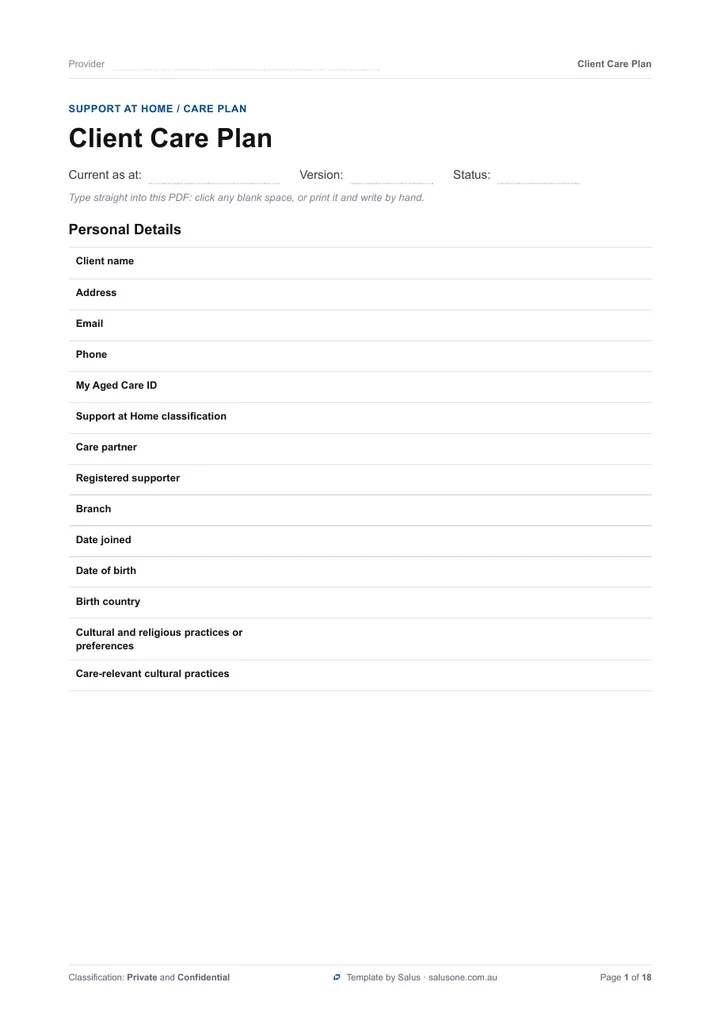
Free templatesSupport at Home Care Plan template and checklistTwo fillable PDFs: the plan, and the checklist to test it before it is approved. No sign-up.
Key points
Care partners prepare the Care Plan with the client, or their carer or registered supporter, in line with the client's Notice of Decision and support plan, before or on the day care starts.
It sets out the client's goals, the strategies to reach them, their preferences, the agreed services (who, when and how often), any assistive technology or home modifications with their costs, how risks are managed, and dates to review the plan and the service agreement.
It is reviewed at least every 12 months, and sooner when needs, goals, preferences, services, risks or informal supports change.
The Care Plan sits inside care management, which for ongoing services is funded from 10% of each client's quarterly budget. The record keeping that goes with care planning is claimed from that same funding.
Where this comes from: the Department's Support at Home guidance and the strengthened Aged Care Quality Standards, linked at the end. The Department calls the people who receive Support at Home “participants”; this guide says “client”.
Informs the planNotice of Decision and support planWhat the client is approved for
The plan
Care Plan
Needs, goals, preferences and services
- Goals
- Strategies
- Preferences
- Services
- Risks
- Reviews
Funds its servicesIndividualised budgetWhat the funding covers
Sets the termsService agreementThe terms of service
The Care Plan is the working centre of care management.
Under Support at Home, care management is broader than writing a plan. It covers four kinds of activity:
- Care planning, such as developing and reviewing Care Plans and budgets
- Service planning and management
- Monitoring and reviewing risks and goals
- Support and education that helps clients make informed decisions
Care management starts when services begin and continues while the client is in your care. In practice, that means at least one direct care management activity of at least 15 minutes every month: a conversation or meeting with the client or their registered supporter. For ongoing services it is funded by a 10% deduction from each client's quarterly budget, pooled across the provider's clients in each service delivery branch.
The Care Plan is where that work is written down. A care partner comes back to it in every care discussion, alongside the service agreement and the individualised budget. Support workers use it to know what good care looks like for this person.
Four documents sit close together and are easy to blur:
| Document | Where it comes from | Its job |
|---|---|---|
| Notice of Decision and support plan | The client's assessment | What the client is approved for and their assessed needs. The Care Plan is prepared in line with them. |
| Care Plan | The care partner, with the client | The client's needs, goals and preferences, and the services that will meet them |
| Individualised budget | The care partner, alongside the Care Plan | What the client's funding covers, so the plan is affordable |
| Service agreement | The provider and the client | The terms on which services are provided |
On the Restorative Care Pathway, a goal plan takes the place of the Care Plan.
What a Support at Home Care Plan has to contain.
A Care Plan has a set list of contents. On top of that, it has to work: personal to the client and up to date, true to what their assessments found, clear about risks and how workers help manage them, offered to the client, and used by the people delivering care. The table pairs each required part with what it looks like when it works.
| What it must include | What it looks like done well |
|---|---|
| The client's goals | In the client's own terms, and specific enough to tell whether they are being met |
| Strategies to reach them, including wellness and reablement | What the client will do, what workers will do and what equipment helps, starting from what the person can do for themselves |
| Preferences: the gender or other attributes of workers, preferred days and times, cultural preferences | Written so a worker meeting the client for the first time could honour them |
| The agreed services: who delivers them, when and how often | Each service traced to a need or goal, and matching the service agreement and the budget |
| Assistive technology and home modifications, with their costs | What was approved, what it is for and what it costs |
| Dates to review the Care Plan and the service agreement | The next scheduled reviews, and the events that would bring the plan's review forward |
| Strategies to identify and manage risks | Each risk of delivering care to this client, with what workers do to help the client manage it |
| Notes on culturally safe, trauma-aware and healing-informed delivery | Practical instructions a worker can follow, not a statement of values |
Write the plan so the client understands it, in the way they prefer to communicate. The client, or their registered supporter, gets a copy when it is complete, whenever it is updated, and whenever they ask for one.
From assessment to a personalised plan.
A Care Plan starts from what is already known about the client. The usual sources are:
- The Notice of Decision and support plan from their assessment
- Letters and reports from their GP or allied health, with the client's agreement
- Hospital discharge summaries
- The previous Care Plan, for clients who moved across from a Home Care Package
- Care notes from workers and care partners, which should be reviewed regularly to keep the plan current
Turning those into a plan follows the same steps every time:
Gather the sources and note their dates. A two-year-old assessment and last week's care note do not carry the same weight.
Look for where they disagree. If one record says the client showers independently and a later care note says she now needs help, raise it with her, then record what you decided and why.
Turn assessed needs into goals in the client's own words.
Write strategies that start from what the person can do, then the help they need.
Match services to goals, then check them against the service agreement and the individualised budget.
Name the risks and what workers should do about each one.
Agree the plan with the client in plain language, and give them a copy.
The difference between a complete plan and a personal one shows in the detail. Take a client in her late seventies who lives alone in a single-storey unit and has stopped going to choir.
Written generally
Goal
Maintain social connection.
Strategy
Assist with mobility as required.
Risk
Falls risk.
Service
Transport as needed.
Written for her
Goal
Get back to choir each week, which she stopped when getting there became too hard.
Strategy
Prompt her to use her single-point stick whenever she goes outdoors.
Risk
She reported a near-trip at the garden step in September, and the step is a known trip hazard. Raise a home modification assessment at her next care discussion.
Service
Transport to and from choir each week.
Goal
Written generallyMaintain social connection.
Written for herGet back to choir each week, which she stopped when getting there became too hard.
Strategy
Written generallyAssist with mobility as required.
Written for herPrompt her to use her single-point stick whenever she goes outdoors.
Risk
Written generallyFalls risk.
Written for herShe reported a near-trip at the garden step in September, and the step is a known trip hazard. Raise a home modification assessment at her next care discussion.
Service
Written generallyTransport as needed.
Written for herTransport to and from choir each week.
Neither column is wrong. Only one tells a new worker what to do on their first visit.
Write it for the people who will use it.
A Care Plan has several readers, and each needs something different from it:
- The client and their supporters need a plan they recognise and can follow, in plain language.
- Support workers need what to do, what to watch for and what the client prefers. If they can't use it, the plan isn't doing its job.
- A care partner covering leave needs the current picture without opening every source.
- A clinician joining the client's care needs the risks, the recent changes and who to contact.
- A reviewer needs to see what changed since the last version, and why.
One test covers most of them:
Could a worker who has never met the client deliver good care from this plan on their first visit?
Plans usually fail that test in the same few ways:
- Goals are copied from one client to the next.
- “As required” stands in for what is actually required.
- Statements carry no date, so no one can tell what is current.
- Services drift away from the service agreement or the budget.
- Clinical terms appear that the client would not use or understand.
Why plans go stale, and what should bring a review forward.
The annual review is the minimum: at least once every 12 months, with the client. Most reviews, though, should be triggered by something that has happened.
Review the whole plan4 events
| Event | Where it shows up first |
|---|---|
| The client asks for a review | A care discussion or a phone call |
| The client begins the End-of-Life Pathway | The pathway approval |
| Daily living, cognition, mental health or physical condition changes | A worker's observation, a GP letter, a discharge summary |
| A transition, such as a hospital stay | A discharge summary |
Recheck part of the plan9 events
| Event | Where it shows up first | What to recheck |
|---|---|---|
| Needs, goals or preferences change | Care notes, a care discussion |
|
| A higher classification is approved | A new Notice of Decision |
|
| Assistive technology or home modifications are approved | A new Notice of Decision |
|
| Interim funding becomes full funding | The budget |
|
| The client wants to change services, or how often they get them | A care discussion |
|
| A new risk or incident affects the client | An incident report, care notes |
|
| Support from family, carers or registered supporters changes | A care discussion, care notes |
|
| The plan isn't working | Care notes, feedback |
|
| Care responsibility changes between others involved | A care discussion, a referral |
|
Triggers rarely arrive labelled. They turn up inside a care note, a discharge summary or a phone call, and a plan stays current only if someone reads those and connects them back to it.
Two things follow a change. Whenever the Care Plan changes, review the individualised budget at the same time. And if the client's needs have changed beyond what they are approved for, the care partner can request a Support Plan Review through My Aged Care, with the client's consent. It can lead to a new assessment.
Where the time goes.
A good Care Plan is mostly reading and reconciling, not typing. The work runs the same way each time:
- Find the sources
- Read them
- Reconcile what disagrees
- Draft
- Check the draft against the service agreement and budget
- Discuss it with the client
- Revise
- Share the final copy
Every review repeats most of it.
All of it is paid from the same care management funding, pooled for each service delivery branch: the record keeping that goes with care planning is claimed from it, and so are the conversations with clients. Every hour spent rebuilding a client's history from scattered documents is an hour that funding can't spend on the conversations that make plans good.
To see the load on your own team, count the plan events in a year across a caseload:
- New Care Plans: one for each client who starts care.
- Scheduled reviews: at least one per client.
- Event reviews: one for each trigger in the table above that turns up in a client's records.
- Direct care management activities: at least 12 per client.
A caseload of 120 clients means at least 120 scheduled reviews and 1,440 monthly contacts a year, before a single new client or event review.
One client's year
× 120 clients
1,440monthly contacts
120scheduled reviews, at least
Multiply the plan events by your own average time per plan. If you don't know that number, time a handful of reviews, from the first document opened to the client's copy.
Faster preparation is worth having only if the time goes back into care.
The parts to protect
- The conversation with the client
- The judgement on conflicting information
- The approval
The parts worth streamlining
- Finding, reading and reconciling records
- The first draft
- Formatting
- Keeping track of versions
Where Salus fits.
Salus prepares
Salus brings a client's records together, prepares a draft Care Plan, marks each part with the record it came from, and lists what is missing or conflicting for your team to check. When new information arrives, it prepares the next version with the changes shown. Draft Ready means ready for your team's review, never approved.
Your team decides
Your care partner checks the sources, talks with the client, makes the changes and approves the plan. Salus doesn't decide services, classifications or anything clinical, and responsibility for the plan stays with the provider.
Eight questions to ask of any Support at Home Care Plan.
Support at Home Care Plan check
0 of 8 ticked
Questions.
A care partner at the provider, with the client and their carer or registered supporter, in line with the client's Notice of Decision and support plan.
Ask Salus
Before or on the day care starts.
Ask Salus
At least once every 12 months, and sooner when the client asks or when their needs, services, risks or informal supports change. The table above lists every trigger.
Ask Salus
No. The service agreement sets the terms between the provider and the client. The Care Plan sets out the client's needs, goals and preferences and the services that meet them. Care discussions review both, with the individualised budget.
Ask Salus
Providers develop a goal plan instead of a Care Plan.
Ask Salus
Sources.
Every fact in this guide comes from these official sources. The web pages were opened and read on 2 November 2026; chapters 7 and 8 of the program manual were read in full on 3 November 2026.
- Care plans for Support at Home participants
Department of Health, Disability and Ageing
- Last updated
- 31 October 2025
- Used for
- What a plan includes, who prepares it and when, copies, review triggers, the Restorative Care Pathway goal plan
- Care management for Support at Home
Department of Health, Disability and Ageing
- Last updated
- 31 October 2025
- Used for
- The four kinds of care management, the monthly direct activity, 10% funding, care notes, care discussions
- Outcome 3.1: Assessment and planning
Aged Care Quality and Safety Commission
- Last updated
- 16 October 2025
- Used for
- What a plan must be under the Standards, and the review triggers they add
- Strengthened Aged Care Quality Standards
Aged Care Quality and Safety Commission
- Last updated
- Current
- Used for
- In force since 1 November 2025
- Support at Home program
Department of Health, Disability and Ageing
- Last updated
- 27 October 2026
- Used for
- Support at Home started on 1 November 2025
- Support at Home program manual, version 4.4
Department of Health, Disability and Ageing
- Last updated
- September 2026
- Used for
- Chapters 7 and 8 read in full on 3 November 2026: what a care plan should include, review triggers, the monthly direct activity of at least 15 minutes, pooled care management funding and what can be claimed from it, Support Plan Reviews
General information for providers, not legal or clinical advice. Check the official sources for your own circumstances.
Related reading.
Support at Home Care Plan checklist and template
Check a plan before sign-off, with a structure you can adapt.
Support at HomeCare planning for Support at Home
How Salus prepares Care Plans from the records you hold.
How it worksHow Salus works
From the records you hold to a plan your team approves.
Clinical governanceClinical governance in Salus
Sources, review states and what stays with your team.
See Salus in action.
Walk through a client's Care Plan with our team, from the records to your team's review.