Guide · CHSP
CHSP service agreements and care and services plans: which is which.
A CHSP service agreement is the contract between you and the client. It sets out the services by name, when they start, what the client contributes for each, how the agreement is reviewed and varied, the cooling-off period, when services can stop and how the client is involved in decisions. The care and services plan centres on the client: their needs, goals and preferences, how risks are managed, and the services that meet them, with how often and how much. Every CHSP client has needed both since 1 November 2026. They are reviewed on the same cycle and must agree with each other. Put the terms in the agreement and the care in the plan.
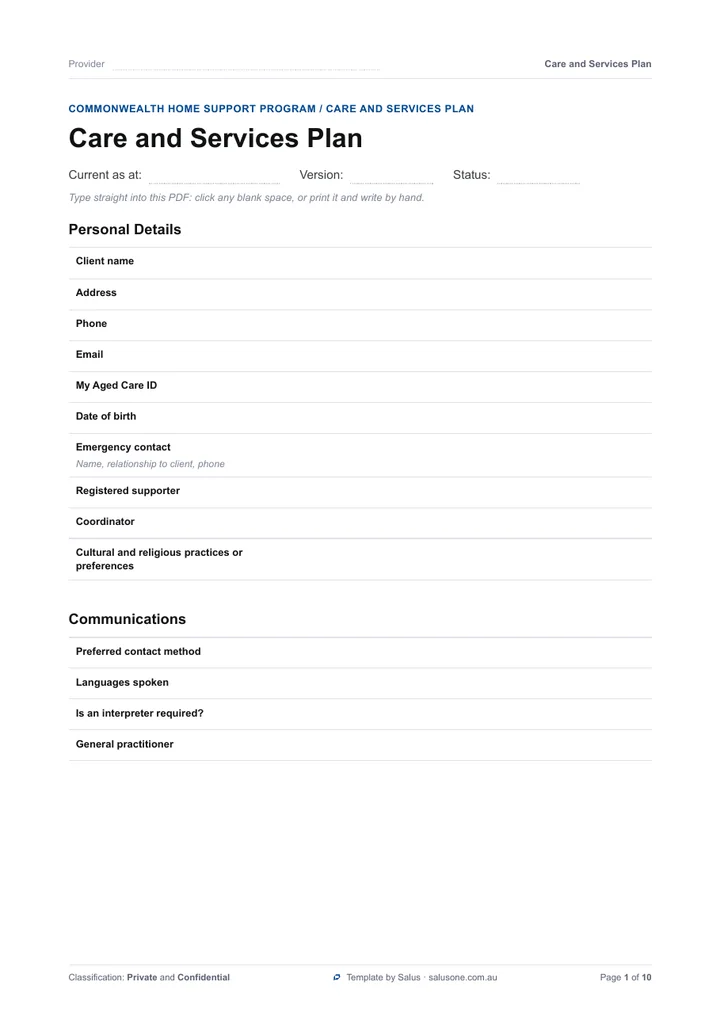
Free templatesCHSP care and services plan template and checklistTwo fillable PDFs: the plan, and the checklist to test it before it is approved. No sign-up.
Key points
The service agreement is the contract. The care and services plan is about the person.
Both must be in place on or before the client's start day.
Both are reviewed at least once every 12 months for ongoing services. The agreement is also reviewed whenever the client asks; the plan is updated whenever their needs, goals, preferences or situation change.
The services in the plan must match the services in the agreement, and both must sit within the support plan from the client's assessment.
A client using more than one CHSP provider has a service agreement with each.
Where this comes from: the Aged Care Rules 2025, the Department's CHSP service agreement guidance and My Aged Care, linked at the end.
Agreement
Service agreement
The contract: the terms and conditions
Services
Domestic assistance, ongoing
Social support group, ongoing
- Contributions
- Review and variation
ProviderClient
The plan
Care and services plan
Centred on the client's needs and choices
His goalStay in his own home and keep going to the group.
Services
Domestic assistance, one and a half hours each fortnight
Weekly social support group
- Risks
Side by side.
| Service agreement | Care and services plan | |
|---|---|---|
| What it is | A contract setting out the terms and conditions | A plan centred on the client's needs and choices |
| Must contain | The parties and contact details, including the client's My Aged Care number; supporters' contact details; a copy of the client's access approval (their Notice of Decision, or their support plan until one arrives) and their classification, usually CHSP; the services by their CHSP service list names, with a start date for each and an end date for short-term ones; any services delivered by an associated provider; the fees and contribution for each service; a statement that the client agrees to pay applicable fees; when services can stop; how and when the agreement can end; the review date; how the client is involved in decisions about how, when and by whom services are delivered | The client's current care needs, goals and preferences; strategies for risk management and preventative care; the services with their frequency and volume or duration; when the plan will be reviewed; for ongoing services, when the agreement will be reviewed |
| How it is developed | Negotiated with the client, with a supporter or family member present if the client asks; in plain language; the client helped to understand it | With the client, their supporters and others involved in their care, through ongoing communication |
| When it is in place | On or before the start day | On or before the start day |
| Review | At least every 12 months for ongoing services, and when the client asks | At least every 12 months for ongoing services, and whenever needs or circumstances change |
| How it changes | Varied only by mutual consent, after proper consultation (the Department's template asks for the client's written consent); the one exception is a change needed to comply with GST law, made with reasonable written notice | Updated with the client whenever something changes |
| Cooling-off | The client can withdraw within 14 days of entering it and before their start day, with any fees or contributions refunded | None |
One client, two documents.
Take a man in his late seventies who receives help around the home every fortnight and goes to a weekly social support group. The same services appear in both documents, said in different ways.
| In the service agreement | In the care and services plan |
|---|---|
| Domestic assistance, starting on the agreed start date, ongoing | Domestic assistance, one and a half hours each fortnight: floors, bathroom and bed linen |
| Social support group, starting on the agreed start date, ongoing | Weekly social support group; he wants to keep seeing the friends he made there after his wife died |
| His contribution for each service, as set by your contribution policy | Not here |
| Review of this agreement by the date in it, and whenever he asks | Review of the plan by its date, and whenever his needs change |
| How he is involved in decisions about how, when and by whom services are delivered | His preference for the same worker where possible, and for mornings |
| Not here | His goal: stay in his own home and keep going to the group |
| Not here | Risk: he has stopped driving at night; transport is booked for daytime only |
Notice what lives in only one place. Money and terms belong in the agreement. Goals, risks and how he likes things done belong in the plan. The services sit in both and have to match.
Common mix-ups.
| What happens | Why it's a problem | Where it belongs |
|---|---|---|
| The plan lists the client's contribution | It turns a care document into a billing one | The service agreement |
| The agreement describes goals and preferences | Terms get mixed with care, and the plan gets thinner | The care and services plan |
| A service is changed in one document only | The two disagree, and so may the invoice | Both, at the same time |
| Review dates don't line up | Two reviews where one would do, or one missed | Both, checked together |
Keep them in step.
The two documents drift apart when they are changed at different times by different people. Three habits keep them aligned:
Review them together. For ongoing services both are due at least once every 12 months, so one conversation can cover both.
When one changes, check the other the same day.
Make one person responsible for each client's pair.
When a client needs new services, they must be approved first: if there is no referral for a service, a Support Plan Review comes before anything changes. Once it is approved, vary the agreement and update the plan together. A review that changes nothing doesn't need a new agreement, but record that it happened: the outcome of each service agreement review goes in the client's My Aged Care record. Reviews can be done by phone or face to face.
When a client has more than one provider.
If a client gets CHSP services from more than one provider, they need a service agreement with each one, and each provider develops a care and services plan for the services it delivers. Where you know another provider is involved, note it in your plan and share what matters, with the client's consent, so the client isn't asked the same questions twice.
Where Salus fits.
Salus prepares
Salus prepares care and services plans. It brings the client's records together, prepares a draft plan in your format with each part traced to its source, and lists what is missing or conflicting across the records you give it.
Your team decides
It doesn't write service agreements, set contributions or decide services; those stay with your team. Draft Ready means ready for your team's review, never approved.
Questions.
No. The service agreement is the contract between the provider and the client. The care and services plan sets out the client's needs, goals and preferences and the services that meet them.
Ask Salus
Yes. Since 1 November 2026, every CHSP client must have a service agreement and a care and services plan.
Ask Salus
The parties and their contact details, including the client's My Aged Care number; a copy of the client's access approval and their classification; the services by their CHSP service list names, with start dates and, for short-term services, end dates; any services delivered by an associated provider; the contribution for each service; when services can stop; how the agreement can end; the review date; any support persons; and how the client is involved in decisions about their services.
Ask Salus
Yes, if they consent but can't sign, for example because of physical incapacity or for cultural safety reasons. The provider keeps detailed records of the client's consent, such as a copy of the agreement offered and a dated note of the discussion. Without the client's consent there is no agreement, so no subsidised CHSP services and no contribution.
Ask Salus
Yes. The Department publishes a service agreement template and a user guide with its CHSP guidance materials.
Ask Salus
The client can withdraw from the agreement within 14 days of entering it, as long as their services haven't started, and any fees or contributions paid are refunded.
Ask Salus
Sources.
Every fact in this guide comes from these official sources. The web pages were opened and read on 2 November 2026; the Service Agreement User Guide was read in full on 3 November 2026.
- Aged Care Rules 2025
Federal Register of Legislation
- Last updated
- Compilation No. 12, 1 October 2026
- Used for
- Service agreements: when entered, how developed, cooling-off, variation, review; contents, including the CHSP-specific fees and contributions; care and services plans
- CHSP Service Agreement guidance materials
Department of Health, Disability and Ageing
- Last updated
- 31 August 2026
- Used for
- Both documents for every client from 1 November 2026; what the agreement reflects; the published template and user guide
- Agreeing to CHSP services
My Aged Care
- Last updated
- No date shown
- Used for
- Contract versus plan, in the client's terms; verbal agreement; a separate agreement with each provider
- CHSP Service Agreement User Guide, version 2
Department of Health, Disability and Ageing
- Last updated
- September 2026
- Used for
- Read in full on 3 November 2026: what the agreement must reflect from 1 November 2026, consent without a signature, reviews with no change, variations, multiple providers
- Responsibilities of CHSP providers
Department of Health, Disability and Ageing
- Last updated
- 9 February 2026
- Used for
- The contribution policy discussed before services start and documented in the agreement
General information for providers, not legal or clinical advice. Check the official sources for your own circumstances.

See Salus in action.
See a CHSP care and services plan prepared from a client's records, with our team.