Guide · CHSP
CHSP care and services plans: a practical guide for providers.
Since 1 November 2026, every CHSP client must have two documents: a CHSP service agreement and a care and services plan, both meeting the Aged Care Act 2024 and the Aged Care Rules 2025. The plan describes the client's current needs, goals and preferences, the strategies for managing risk and preventing decline, and the services you will deliver, with how often and how much. It is developed with the client before or on the day services start, and reviewed at least every 12 months. One good plan is not hard to write. A consistent plan for every client, kept current by a team built to deliver services rather than documents, is the real task.
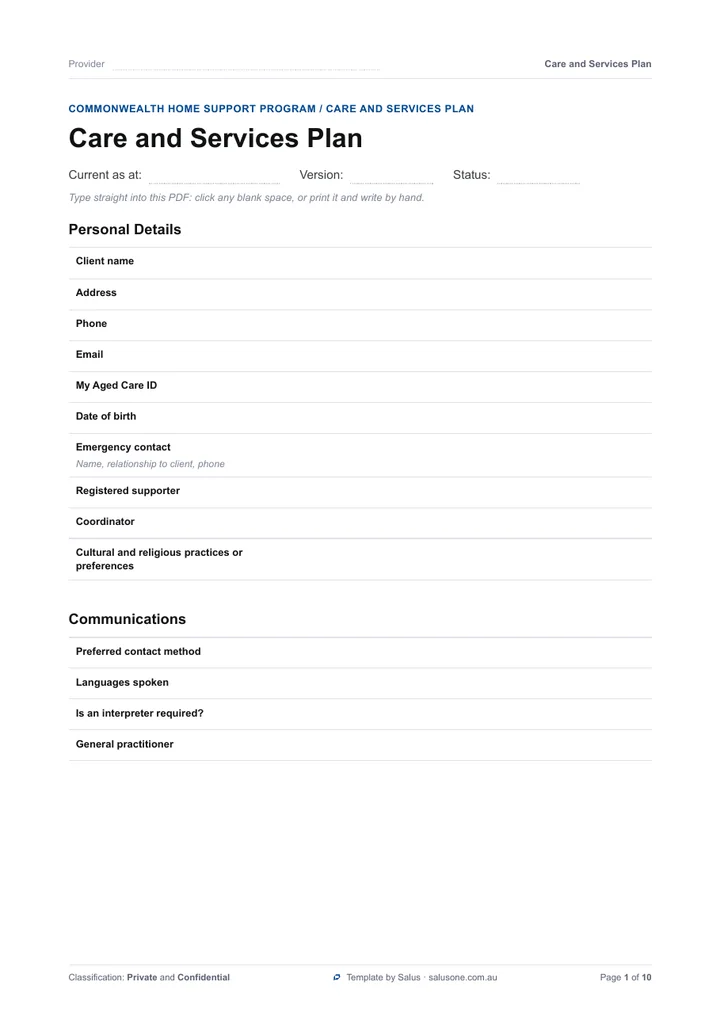
Free templatesCHSP care and services plan template and checklistTwo fillable PDFs: the plan, and the checklist to test it before it is approved. No sign-up.
Key points
The transition arrangements for existing CHSP clients ended on 1 November 2026. Every client now needs a service agreement and a care and services plan.
The plan is developed with the client, their supporters and anyone else involved in their care, on or before the day services start. The client gets a copy when it is developed, whenever it changes and whenever they ask.
It must record the client's details and any registered supporter, describe their current care needs, goals and preferences, include strategies for risk management and preventative care, set out each service with its frequency and its volume or duration, and say when the plan and the service agreement will be reviewed.
The service agreement is the contract. The plan centres on the client. Both are reviewed at least every 12 months for ongoing services.
Where this comes from: the Aged Care Rules 2025, the Department's CHSP guidance and My Aged Care, linked at the end.
Aged care assessor
Support plan
The services the client is approved for
The plan
Care and services plan
Centred on the client: needs, goals, preferences, services
Her goalKeep doing her own shopping each week.
- Goals
- Preferences
- Services
- Review
Agreement
Service agreement
The contract: services, terms, contributions
ProviderClient
Why every CHSP client now needs a plan.
The Aged Care Act 2024 began on 1 November 2025. From that day, CHSP providers became registered providers, and the Aged Care Rules set out what their service agreements and care and services plans must contain. Existing clients were given a year: transition arrangements let their old arrangements stand until 1 November 2026. That year is over. Every CHSP client, including someone who has had the same fortnightly cleaning for a decade, now needs a service agreement and a care and services plan that meet the new rules.
Providers start from different places. Some have planned with every client for years and now need to check their format against the rules. Others have relied on the assessor's support plan and a record of services delivered, and are writing plans for the first time across hundreds of clients. Both end up at the same baseline, and both have to keep it there.
It is also not a short exercise. CHSP funding has been extended to 30 June 2029, and the Department has said it will consult on the program's longer-term future. Plans written now will need to keep working, and keep being reviewed, for years.
Two documents, two jobs.
CHSP has two client documents of its own, and they draw on a third that the provider doesn't write.
| Document | Who writes it | Its job | When it changes |
|---|---|---|---|
| Support plan | The aged care assessor | The services the client is approved for. Providers must follow it. | When the client is reassessed or their support plan is reviewed |
| Service agreement | The provider, negotiated with the client | The contract: the services by their CHSP service list names, start dates, the client contribution for each service, review and variation arrangements, the cooling-off period, when services can stop, and how the client is involved in decisions | Reviewed at least every 12 months and when the client asks; varied by agreement |
| Care and services plan | The provider, developed with the client | The client's needs, goals and preferences, how risks are managed, and the services that meet them, with how often and how much | Reviewed at least every 12 months for ongoing services, and updated whenever needs, goals, preferences or circumstances change |
For clients, the difference is simple: the service agreement sets out the terms and conditions, while the plan centres on their needs and choices. The two have to agree with each other, and both have to sit within the support plan. Our guide to CHSP service agreements and care and services plans covers the boundary in detail.
What a CHSP care and services plan must contain.
The Rules and the Department's checklist guidance set a short list of contents. The table pairs each one with what it looks like when it works.
| What the plan must include | What it looks like done well |
|---|---|
| The client's details and contact information | Name, contact details, My Aged Care ID and an emergency contact, plus anything about their situation that matters for delivering services |
| The client's current care needs | Written from today's situation, not copied from an assessment that is two years old |
| Their goals | In the client's own words, specific enough to tell whether they are being met |
| Their preferences | Who they would like to support them, which days suit, cultural and language needs, anything that makes a visit go well |
| Strategies for risk management | Each risk named, with what the worker should do or watch for |
| Strategies for preventative care | What keeps the client doing things for themselves: the wellness and reablement approach CHSP expects |
| The services you will deliver | Each service by name, with how often and for how long, matching the service agreement |
| When the plan will be reviewed | A date, and the events that would bring it forward |
| When the service agreement will be reviewed | For ongoing services, the agreement's own review date |
| Any registered supporter, and who was involved | The supporter's details, and who helped develop the plan |
Four requirements sit around the contents:
- The plan is developed through ongoing communication with the client, their supporters (if they have any) and others involved in their care.
- It is written in clear, concise language the client can understand.
- It is in place on or before the client's start day, or within 28 days in a few circumstances the Act allows, such as an urgent start before the client's approval came through.
- The client, and their registered supporter or other support person, get a copy when it is developed, whenever it is updated and whenever they ask for one.
If some of your services fall under other registration categories, such as personal care or nursing, the strengthened Aged Care Quality Standards add an expectation for those services: plans are regularly reviewed, and workers use them to guide the care they deliver.
Two things the Rules don't ask for are worth recording too: why the client needs support, usually a health or medical reason or a physical one, and their health and physical needs. Recorded from the start, they give each review something to compare against, so a decline shows early, and they make a move to Support at Home easier if the client's needs grow beyond CHSP.
The Department publishes a checklist for care and services plans and a service agreement template, but no plan template. Our CHSP care and services plan checklist includes a plan structure you can adapt, with a place for each.
A CHSP plan can be short. It can't be vague.
Most CHSP clients receive entry-level support: help around the house, transport, meals, social support. Their plans don't need to run to many pages. What they need is detail a worker can act on. Take a woman in her early eighties who lives alone, has fortnightly help with cleaning and weekly transport to the shops, and has started to tire more easily.
Written generally
Goal
Maintain independence.
Preference
Nil.
Risk
Falls risk.
Preventative care
Not recorded.
Service
Domestic assistance, fortnightly.
Written for her
Goal
Keep doing her own shopping each week, which she has done since she moved into the unit.
Preference
A female worker for help in the home; morning visits, when she has the most energy.
Risk
She uses a walking stick outdoors, and a paver on the front path has lifted. The worker checks the path on arrival and reports any change.
Preventative care
She and the worker change the bed together, so she keeps the reach and strength to do it between visits.
Service
Domestic assistance, one and a half hours each fortnight: floors, bathroom and bed linen. Transport to the shops each week.
Goal
Written generallyMaintain independence.
Written for herKeep doing her own shopping each week, which she has done since she moved into the unit.
Preference
Written generallyNil.
Written for herA female worker for help in the home; morning visits, when she has the most energy.
Risk
Written generallyFalls risk.
Written for herShe uses a walking stick outdoors, and a paver on the front path has lifted. The worker checks the path on arrival and reports any change.
Preventative care
Written generallyNot recorded.
Written for herShe and the worker change the bed together, so she keeps the reach and strength to do it between visits.
Service
Written generallyDomestic assistance, fortnightly.
Written for herDomestic assistance, one and a half hours each fortnight: floors, bathroom and bed linen. Transport to the shops each week.
Neither column breaks a rule on its own. Only the second tells a new worker what to do, and gives a reviewer something to check a year from now.
A repeatable way to put plans in place.
Consistency comes from doing the same steps in the same order for every client. A process that works for one coordinator and a few clients has to work for a team and several hundred.
List every active client and what you hold for each: the support plan, the service agreement, the last review, recent service notes and who their supporters are.
Sort them into three groups. Ready: records are current, and a conversation will confirm the plan. Missing information: records are old, thin or missing. Talk first: something has changed, such as a hospital stay, a complaint, a new risk or a carer who has stepped back.
Draft each plan from the records you hold, and mark what is missing or doesn't agree.
Talk with the client, and their supporter if they want one there. Confirm the goals and preferences in their words, and settle anything the records disagree on.
Check the services against the service agreement and the support plan, then approve the plan and give the client a copy.
Set the plan's review date and the service agreement's review date, and record both where your team will see them.
Keep a short list of clients whose plans can't be finished yet, and why: a supporter who hasn't returned a call, a GP letter you are waiting on, a client in hospital. That list is the honest measure of where you are, and the same process carries on for every new client before their first service.
Keeping plans current across a large client base.
For ongoing services, the plan is reviewed at least once every 12 months. Time-limited services are reviewed by their scheduled review date. Between reviews, the plan is updated whenever the client's needs, goals, preferences or situation change, and the client can ask for changes at any time.
Two things make that harder in CHSP than it sounds.
The first is timing. If most of your plans were written in the months before 1 November 2026, most of their annual reviews will fall due in the same months of 2027. Spread them now: bring some reviews forward to a natural contact point, such as a change of service or a supporter's visit, so next year's load is even.
Left as written
Spread now
The second is noticing change. CHSP workers often see a client for an hour or two a fortnight. Change shows up as a line in a service note, a missed social support day or a call from a daughter. A plan stays current only if someone reads those and connects them back to it.
Sometimes the change is bigger than CHSP, which isn't designed for intensive or complex needs. The next step is a Support Plan Review: you request it with the client through the My Aged Care Service and Support Portal, and an aged care assessor carries it out. It can lead to more or different services, or to a reassessment and Support at Home. The same request applies when a carer is no longer available, a client wants new services, or a time-limited period ends. And when a client's goals have been met and they no longer need services, they are discharged. Our guide to moving from CHSP to Support at Home covers what to prepare.
What it takes: a model to test with your own numbers.
The work behind a plan is mostly finding and reading records, a conversation, writing, checking and approval. To see what that means for your team, use your own timings in a simple model. The figures below are assumptions to replace, not benchmarks.
| Assumption | Value to replace | Hours |
|---|---|---|
| Active clients without a current plan | 600 | |
| Time per new plan, from first record opened to the client's copy | 90 minutes | 900 |
| Clients reviewed in the following year | 600 | |
| Time per annual review | 45 minutes | 450 |
| Updates after a change, as a share of clients | One in four, at 30 minutes each | 75 |
900hours to put plans in place
525hours a year to keep them current
On those assumptions, putting plans in place takes 900 hours, roughly 24 weeks of one full-time coordinator, and keeping them current takes about 525 hours a year after that. Multiply by your own loaded hourly cost to see the money. Then ask which parts of that time are the conversation and the judgement, which you want to keep, and which are searching, retyping and formatting, which you don't.
Where Salus fits.
Salus prepares
Salus brings a client's records together, including the assessor's support plan, the service agreement, service notes and letters. It prepares a draft care and services plan in your format, marks each part with the record it came from, and lists what is missing or conflicting for your team to check. When something changes, it prepares the next version with the changes shown. Across your clients, it shows which plans are waiting for review and which are due.
Your team decides
Your coordinator talks with the client, settles what the records disagree on, makes the changes and approves the plan. Salus doesn't write service agreements, set client contributions or decide services, and responsibility for the plan stays with the provider. Draft Ready means ready for your team's review, never approved.
Questions to ask your leadership team.
CHSP plans: a leadership check
0 of 6 ticked
Questions.
Yes. Since 1 November 2026, every CHSP client must have a care and services plan as well as a service agreement.
Ask Salus
On or before the client's start day. In a few circumstances, such as an urgent start before the client's approval came through, it is due within 28 days of the first service.
Ask Salus
At least once every 12 months for ongoing services, by the scheduled review date for time-limited services, and whenever the client's needs, goals, preferences or situation change.
Ask Salus
No. The service agreement is the contract between the provider and the client. The plan centres on the client's needs, goals and preferences and the services that meet them. They are reviewed on the same cycle and must agree with each other.
Ask Salus
The Department publishes a checklist for care and services plans and a service agreement template. It doesn't publish a plan template.
Ask Salus
Yes: when the plan is developed, whenever it is updated, and whenever they ask. So does their registered supporter or other support person.
Ask Salus
Sources.
Every fact in this guide comes from these official sources. The web pages were opened and read on 2 November 2026; the checklist guidance and the CHSP Manual were read on 3 November 2026.
- Aged Care Rules 2025
Federal Register of Legislation
- Last updated
- Compilation No. 12, in force from 1 October 2026
- Used for
- When a plan is developed, what it contains, who is involved, copies, the 12-month review; service agreement rules and contents, including CHSP fees; the Quality Standards on plans
- Aged Care Act 2024
Federal Register of Legislation
- Last updated
- Compilation No. 2, 1 July 2026
- Used for
- The circumstances where services start before approval
- CHSP Service Agreement guidance materials
Department of Health, Disability and Ageing
- Last updated
- 31 August 2026
- Used for
- The end of transition arrangements on 1 November 2026; what the service agreement reflects; the published templates and checklists
- CHSP Care and Services Plans checklist guidance
Department of Health, Disability and Ageing
- Last updated
- Version 2, September 2026
- Used for
- Read in full on 3 November 2026: what a plan includes from 1 November 2026, the checklist sections, clear language, copies, who was involved
- CHSP 2025–27 Manual, version 5
Department of Health, Disability and Ageing
- Last updated
- September 2026
- Used for
- Read on 3 November 2026 (chapters 1, 4, 5 and 9): CHSP as entry-level support, extended to 2029; wellness and reablement; Support Plan Reviews and reassessment; client monitoring; discharge
- Responsibilities of CHSP providers
Department of Health, Disability and Ageing
- Last updated
- 9 February 2026
- Used for
- Follow the assessor's support plan; both documents reviewed every 12 months or by the scheduled date; wellness and reablement
- CHSP reforms
Department of Health, Disability and Ageing
- Last updated
- 11 September 2026
- Used for
- Funding extended to 30 June 2029
- CHSP extended to 30 June 2029
Department of Health, Disability and Ageing
- Last updated
- 21 August 2026
- Used for
- Consultation on the program's future
- Agreeing to CHSP services
My Aged Care
- Last updated
- No date shown
- Used for
- How clients are told the two documents differ; what a plan covers from the client's side
- Outcome 3.1: Assessment and planning
Aged Care Quality and Safety Commission
- Last updated
- 16 October 2025
- Used for
- Requesting a support plan review or reassessment when needs go beyond what the provider delivers
General information for providers, not legal or clinical advice. Check the official sources for your own circumstances.
Related reading.
CHSP care and services plan checklist
What every plan has to include.
ComparisonService agreements and care and services plans
Which document is which, and who prepares each.
ExplainerFrom CHSP to Support at Home
Planning ahead as a provider.
CHSPCHSP care and services plans
How Salus prepares care and services plans from the records you hold.
How it worksHow Salus works
From the records you hold to a plan your team approves.

See Salus in action.
Walk through a CHSP client's care and services plan with our team, from the records to your coordinator's review.